_Shorty wrote:If that's what you think, good for you. I couldn't disagree more.
Jason wrote:You'd be correct if the targets we shot were absolutely perfectly shaped, specifically with absolutely perfect 90 degree corners. Since they are not, the direct sunlight does indeed hit different areas around the edges depending on where the sun is coming from relative to the target.<snip>
i think what jason was trying to say is that the animals are not 2 dimensional, they are 3 dimensional, and light hitting a stationary animal at different angles during the day also hit different parts during the day...
jasons point that the edges are not perfectly cut or cast at a perfect 90 degrees
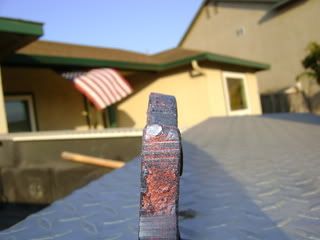
[img][img]
http://i303.photobucket.com/albums/nn14 ... ky/024.jpg[/img][/img]
the targets themselves have depth, and as light hits them different and or you change positions on the shooting line, you either see more of the animal(making them look larger) or less of the animal(making them look smaller)
this pic is straight on at an estimated perpendicular to the animal
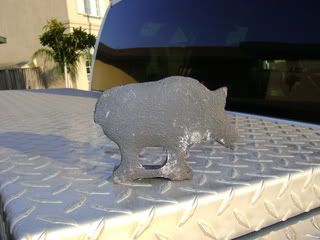
[img][img]
http://i303.photobucket.com/albums/nn14 ... ky/023.jpg[/img][/img]
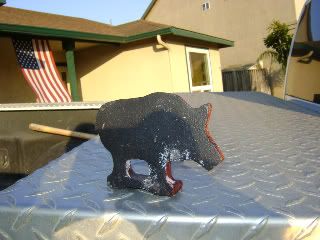
this next picture is taken at an exagerated angle to distinctly show the effect
[img][img]
http://i303.photobucket.com/albums/nn14 ... ky/025.jpg[/img][/img]
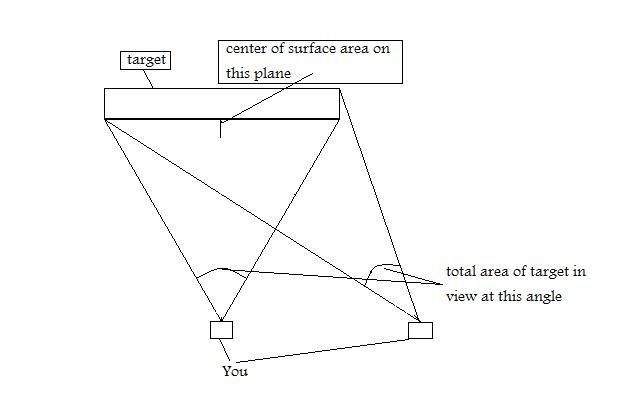
now... a drawing.....
[img][img]
http://i303.photobucket.com/albums/nn14 ... ky/pov.jpg[/img][/img]
( as with every other picture in this post, dimensions and angles have been exagerated to more clearly show effects)
as you view an object from a different angle, (other then absolutly perpendicular) you see more of the object, a view from exactly 90 degrees shows the least amount of the object.
so.... if you look at an object at a different angle, even though the center of the animal remains the same, the surface area you see is balanced off center in relation to the center of the animal when viewed from perfectly 90 degrees, and the animal also looks larger.
also what many people are trying to say is that light, hitting the animal at different angles on different parts of the animal enhance or decrease what you see of the animal, the sides either could be in direct sunlight or in the shadow of the rest of the animal, and since looking through a scope does not magnify the object the same amount as viewing the target from close up, our eyes can not readily recognize that we are also seeing some of the edges of the target. And if the edge is in direct sunlight like the rest of the animal it looks bigger.
Normally when we first get to the range before a match, I check the "chicken zero" on our rifles for the day as I clean my rifles after each match. Usually I shoot a few shots to "warm" the barrel, but the guns start right off shooting very small groups.
I have noticed a 1 MOA change in zero from mornings to afternoons when checking zeros before a match and again between matches in the afternoon. The morning's zero's being 1 MOA lower than the afternoons. Our original assumption was changing temperatures. Honestly I need to start writing down the temp and humidity and where the "chicken zero" is at specific times to try to determine what is causing this.
Has anyone else noticed this and have an explanation?
now to try and also give an idea to the original question,
at different times of the day, the intensity of light from the sun changes, thus either raising or decreasing tempurature, right?
so its generaly accepted as temp increases point of IMPACT rises, so we adjust our scopes to move the crosshairs higher, which should bring POI down, if we use the same poa for the two shots. Vegetation usually absorbs some of light rays intensity i.e.( stand in the grass a hot day, then go stand in the driveway, and you will notice a difference in temperature). so shoot one match in 80 degree weather at one range then go to another range with the same light intensity and if the ground on the range is dirt or if it has vegetation on the ground, and the temp will be different at the two ranges,
another factor could be either a head wind or tail wind, im pretty sure shooting in a headwind will make your poi drop, and a tailwind will raise it, at different times of the day wind shifts one direction or the other, or it could be non existant in the morning and slightly stronger as the day drags on.
another is mirage, if it is non existant you are not seeing light effected by temperature, and your poi is right on par, now i cant quite remember but if mirage is boiling straight up shots are generally high, right? well if it is, tempurature is twisting, turning, and bending light in different ways, and the animal looks like it is higher than it really is, so your poa looks right inside the animal, while poi could either be hitting the animal high in the back or go right over the animal, shorty is right, light does not move the animal, but light which could make the air hotter thus causing mirage, can make the image of the animal we see move, which may cause misses and in travelor's case, headaches, lol
now if mirage causes shots to go low, the above paragraph is still valid, just replaced the word high with low.
i do my best not to think i know it all, but i do know i know half of what i think i know now